The Largest Investment... But Who Is Actually Paying?

What McCracken County wasn't told about the GLE deal.
When Governor Andy Beshear stood before the cameras in March 2026, the headline was hard to argue with. Global Laser Enrichment (GLE) was bringing a $1.76 billion project to Paducah. The single largest private investment in Western Kentucky history. Two hundred and forty jobs. A nuclear future for a city that once powered America's Cold War.
What didn't make the press release was the ledger on the other side of that deal.
Because while GLE is investing $1.76 billion, McCracken County is paying far more — in public subsidies, in ecological losses, in health risks, in waste with nowhere to go, and in the quiet surrender of 665 acres of public wildlife land that belonged to every resident of this county for over 70 years.
McCracken County was shut out of this conversation. The deal was negotiated behind closed doors. The financial terms were hidden behind a nondisclosure agreement. The public comment period closed before the safety analysis was finished. And the land was transferred before most residents even knew it was on the table.
This is the story of what was traded away, what it was actually worth, and what Neapolitan, the tricolored bat, or more affectionately 'NEO', represents for every person in this county who deserved a seat at the table and didn't get one.
Meet NEO
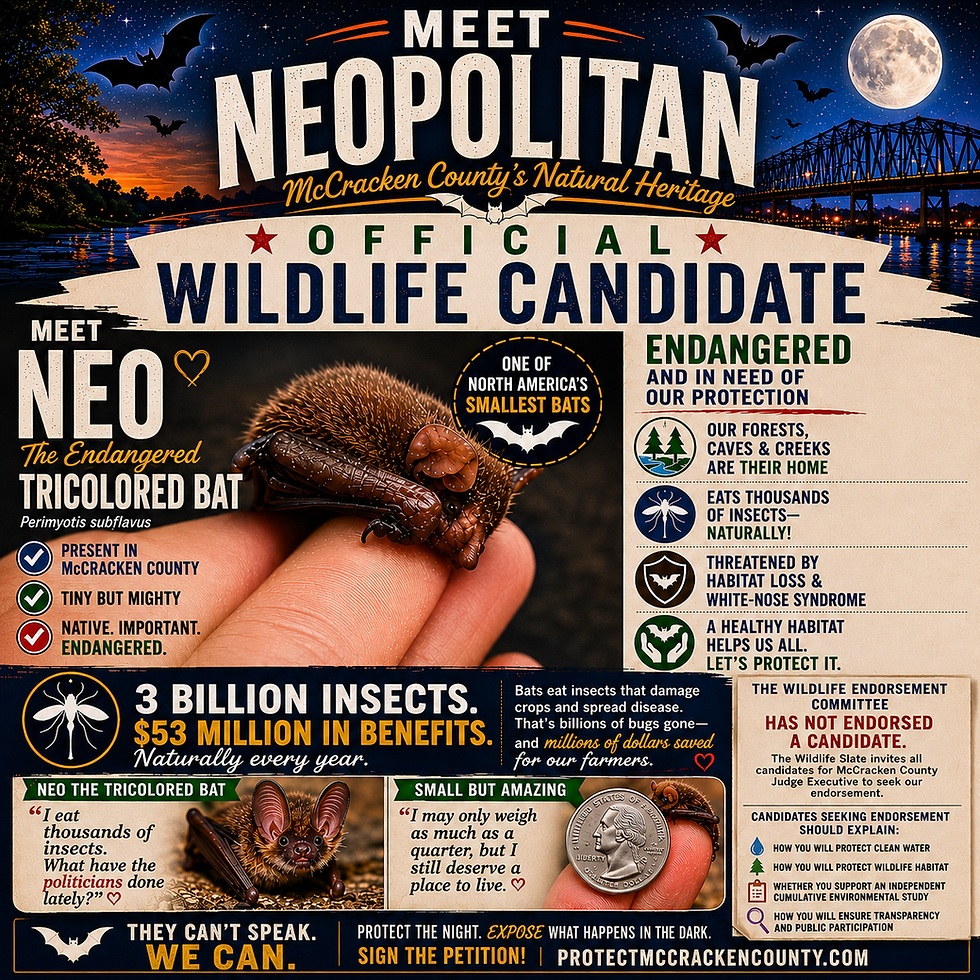
NEO is the tricolored bat (Perimyotis subflavus) — one of North America's smallest mammals, documented living on the 665 acres of West Kentucky public wildlife land transferred to GLE. We named him NEO — short for Neapolitan, like the ice cream — because every single hair on his tiny body carries three colors: dark at the roots, pale in the middle, warm at the tips.
NEO weighs less than a quarter. He can live nearly 15 years. He hunts by sonar in complete darkness, ramping his echolocation from 20 pulses per second to 200 as he zeros in on a moth over a cornfield — doing work that saves McCracken County farmers millions of dollars every year, for free, every single night, all summer long.
His kind is already down 80% across Kentucky. At Mammoth Cave, just east of us, 85% of tricolored bats are gone — killed in their sleep by a fungus called white-nose syndrome that eats their wings while they hibernate.
And then we took their home.
NEO didn't get a seat at the table. Neither did the people of McCracken County.
The Land Nobody Talked About
In late 2024, Kentucky Fish and Wildlife quietly transferred 665 acres of West Kentucky public wildlife land in McCracken County to GLE. The land had been managed for public hunting, fishing, and wildlife observation for over 70 years. In exchange, GLE purchased 1,043 acres of frequently-flooded agricultural bottomland in Fulton County — land routinely inundated by the Mississippi River and already enrolled in a federal wetland reserve program.
Look at what was actually swapped:
What land McCracken County gave up: Mixed hardwood forest, wetlands, open grassland, and creek bottomland — documented habitat for at least six bat species including the federally proposed-endangered tricolored bat, federally endangered Indiana bat and gray bat, migratory songbirds, waterfowl, rare freshwater mussels, pollinators, deer, turkey, and quail. Land that residents had hunted, fished, birded, and hiked for seven decades.
What land was received in return: Frequently-flooded agricultural land in Fulton County — lower per-acre value, far from Paducah, and not accessible to McCracken County residents. Land that was already earmarked for conservation.
The ecological and economic value of those 665 acres was never publicly tallied. We tallied it.
What 665 Acres Was Actually Worth
The Trees
The land's 293 forested acres — mature oak, hickory, and bottomland hardwood — carried an estimated $150,000 to $350,000 in standing timber value alone. That's before counting what those trees did every single day they were standing:
Air filtration: Near-urban forests remove particulates and produce oxygen worth $77,000 to $590,000 per year to surrounding communities.
Carbon sequestration: At 1–2 tons of CO2 per acre annually, those 293 acres were pulling hundreds of cars' worth of emissions from our air every year — permanently.
Stormwater interception: Trees catch millions of gallons of runoff, protecting roads, properties, and waterways from flooding.
Cooling: Forest canopy measurably reduces ambient temperatures in surrounding areas, lowering energy costs for Paducah residents.
The Wetlands
The land's 159 wetland acres were doing work that no water treatment plant in McCracken County was being paid to do:
Water quality filtration: At documented values of $9,000 per acre per year, those wetlands were delivering $1.4 million per year in water purification — removing nutrients, bacteria, sediment, and runoff from Bayou Creek and Little Bayou Creek.
Flood control: One acre of wetland holds 1 to 1.5 million gallons of water. Those 159 acres were holding back roughly 200 million gallons of stormwater per storm event.
Flood damage reduction: Research values wetland flood mitigation at $8,000 per acre per year — another $1.27 million per year in avoided flood costs for downstream properties.
NEO and the Bats
Six species of bats, including NEO the tricolored bat, documented on the property, used this land as summer roosting and foraging habitat.
Each night during the growing season, bats flew 5 to 7 miles from their roost, hunting corn earworms, armyworms, and cutworm moths over surrounding farmland. Corn, soybeans, and wheat fields across McCracken County and the broader Jackson Purchase region benefited from this free nightly pest control.
The economic value: $3 million to $8 million per year in avoided crop losses and pesticide costs. When bat populations decline, insecticide use rises 31%. An Illinois field study found that when bats were excluded from cornfields, crop damage was 50 times higher than in bat-protected fields.
Kentucky has already lost 80% of its tricolored bat population. A population that decimated cannot absorb the casual loss of 665 acres of prime summer habitat — especially after a survey that lasted only 7 nights.
The Freshwater Mussels
Bayou Creek and Little Bayou Creek are home to federally endangered freshwater mussels including the snuffbox, sheepnose, rabbitsfoot, and spectaclecase. Scientists call mussels the "livers of the rivers." Each mussel filters up to 10 gallons of water per day. When a mussel population is harmed, the legal price is steep: a mussel kill on Virginia's Clinch River cost $6.1 million. A kill on Dunkard Creek cost $15 million.
The Pollinators, the Birds, the Food Web
The 665 acres supported wild bees and native pollinators worth an estimated $200,000 to $800,000 per year in services to surrounding farms. It hosted over 200 species of migratory birds along the Mississippi Flyway. It provided breeding and staging habitat for deer, turkey, quail, rabbit, amphibians, and predatory insects that collectively suppressed crop pests across the surrounding landscape.
None of this was counted. None of it was compensated.
The Survey That Should Have Caught All of This
Before a development of this scale can proceed, federal law requires an adequate environmental survey. The U.S. Fish and Wildlife Service conducted an acoustic bat survey of the 665-acre site.
It lasted 7 nights.
The agencies' own published guidelines require a minimum of approximately 75 detector-nights spread across all four seasons for a site this size with documented bat presence. Spring emergence surveys, summer foraging surveys, fall swarming surveys, and winter hibernacula surveys are all distinct requirements — because bats behave entirely differently in each season.
At Mammoth Cave, just east of McCracken County, the tricolored bat has already crashed 85% from white-nose syndrome. This is the context in which a 7-night survey was deemed sufficient.
The Kentucky Resources Council formally petitioned the NRC in May 2026, arguing the entire environmental review violates federal law because it relied on generic data rather than site-specific analysis.
McCracken County Was Shut Out
This is the part of the story that matters most.
The deal to transfer 665 acres of public wildlife land to a private uranium company was negotiated in 2024. McCracken County Judge Executive Craig Clymer confirmed he could not disclose the financial terms of the county's incentive package because it was covered by a nondisclosure agreement. The people of McCracken County — the people who owned that land, who hunted and fished it for 70 years, who will live next to this facility for the next 40 years — were not told.
When the public comment period on the Environmental Impact Statement finally opened, it closed before the NRC's own Safety Evaluation Report was finished. That report isn't due until January 2027. McCracken County residents were asked to evaluate a facility whose full safety profile they were legally barred from seeing.
NEO the tricolored bat was surveyed for 7 nights on land he had used for generations. The people of McCracken County got approximately the same level of consideration.
Some things in this county don't change unless the people demand otherwise.
Who Is Paying — The Complete Ledger
Direct public subsidies to GLE:
$24 million — Kentucky Business Investment tax incentives (15 years)
$3 million — Kentucky Enterprise Initiative Act tax recoup
~$71.9 million — McCracken County incentives (hidden behind a nondisclosure agreement)
$28.5 million — U.S. Department of Energy grant.
Total confirmed public money to GLE: approximately $127 million.
Ecological value surrendered over GLE's 40-year license:
Annual ecosystem services: $7 million to $16 million per year - Over 40 years: $280 million to $640 million.
One-time asset losses: $10 million to $20 million.
Human health and liability costs:
Worker health costs based on Paducah Gaseous Diffusion Plant cancer precedent: $50 million to $200 million.
Community health monitoring, water testing, emergency response: $30 million to $130 million.
Post-decommission cleanup liability: $500 million to $2 billion (taxpayer risk) - 290,000+ metric tons of new radioactive waste stored in McCracken County with no licensed disposal pathway.
The adjacent federal obligation that never leaves:
Paducah Gaseous Diffusion Plant Superfund cleanup through 2065: $17 billion in taxpayer money.
Conservative total public cost: $17.4 billion to $17.8 billion — and rising.
For every $1 GLE invests, McCracken County pays $10.
The Risks Nobody Got to Evaluate
The NRC's Safety Evaluation Report for the GLE facility is not due until January 2027. The public comment period closed May 11, 2026 — eight months earlier.
The SILEX laser enrichment technology GLE will use was classified by the U.S. Secretary of Energy in 2001. Key safety details are withheld as corporate trade secrets. Princeton University's Program on Science and Global Security has published peer-reviewed research concluding that SILEX poses nuclear proliferation risks comparable to or greater than gas centrifuge technology.
The Paducah Laser Enrichment Facility would be the first commercial-scale SILEX facility ever built anywhere in the world. McCracken County would host the world's first full-scale experiment with this technology — adjacent to an existing Superfund site, 5 miles from 65,000 people, with watchdog agencies simultaneously defunded and told to prioritize speed over science.
The Same Pen. The Same Month.
On March 26, 2026, Governor Andy Beshear stood before the cameras and declared GLE's uranium enrichment facility "a game-changing investment for Western Kentucky and our entire commonwealth." He celebrated a deal that transferred 665 acres of public wildlife land in McCracken County — land where the Eastern Hellbender lives, in waterways already carrying contamination from a $17 billion Superfund site next door.
On April 27, 2026 — just 32 days later — Governor Beshear signed Senate Bill 37, naming the Eastern Hellbender Kentucky's official state amphibian.
The same pen. The same month. The same Governor.
The hellbender cannot survive water that is warm, low in oxygen, or contaminated with chemical runoff. GLE's facility will be built adjacent to Bayou Creek and Little Bayou Creek — the exact waterways where the Hellbender lives. This was documented in GLE's own environmental study. It was seen. It didn't matter. His home was traded anyway.
Governor Beshear — we believe you meant it when you celebrated Kentucky's state amphibian. We are asking you to mean it for McCracken County too. Support an independent, site-specific cumulative environmental study. Demand transparency for McCracken County residents. Protect the Hellbender's water.
What McCracken County Deserves
This is not an argument against economic development. Paducah needs jobs. Those 240 positions at $62 per hour represent something real and meaningful to working families.
But a real economic development deal is transparent. It accounts for what's being traded, not just what's being received. It requires an honest survey of what was on the land before it was given away. It doesn't ask the public to comment on a safety analysis that doesn't exist yet. And it doesn't hide $71.9 million in county incentives behind a nondisclosure agreement.
McCracken County was told this was the largest private investment in western Kentucky history.
The ledger tells a different story about who is actually paying.
What You Can Do
Stay updated on KRC's petition to the NRC: Sign up for the Kentucky Resources Council newsletter at https://bit.ly/SubscribeToKRCNews
Contact your representatives: U.S. Senators and House members from Kentucky have oversight authority over the NRC and can formally request an explanation of why a 7-night bat survey was accepted for a 665-acre site with documented endangered species presence.
Visit the NRC docket: Docket NRC-2025-1007 at Regulations.gov. The formal hearing process is still open. Public record matters.
Talk to your neighbors: Most Paducah residents have no idea that the land GLE acquired was home to endangered bats, rare mussels, and 70 years of public wildlife heritage. The best accountability is an informed community.
NEO is still out there — somewhere in the dark above McCracken County's fields, hunting bugs by sonar, doing work nobody is paying for. He has been doing that work for millions of years. He deserves at least a proper count before we decide his home doesn't matter.
So do the people of McCracken County.


Comments